
LESSON 15 · VALUE & LIGHT
Form Shadow vs Cast Shadow
There are two kinds of shadow and they behave completely differently. A form shadow happens because a surface turned away from the light; a cast shadow happens because something blocked the light. Once you can tell them apart, and once you stop letting the shadow family leak into the light family, your forms start looking solid instead of smudged.
55 min
TIME
Intermediate
LEVEL
Photoshop or ArtRage
SOFTWARE
What you'll learn
Separate every value in a picture into the light family or the shadow family
Name the parts: highlight, halftone, terminator, core shadow, reflected light, occlusion
Distinguish a form shadow from a cast shadow by its cause and its edge
Predict shadow edge softness from the size of the light source
Keep reflected light inside the shadow family
Design a shadow as a deliberate flat shape before rendering anything
Before you start
Finish first: L14
- A desk lamp and a white ball, an egg, or an orange
- A cardboard box and a cylinder - a tin or a candle
- A blank 2000x1500 canvas and your five saved value swatches
WATCH
Watch this first
Light and Shadow (10 Min To Better Painting Ep6)
Marco Bucci — Ten minutes that will change how you see light permanently. Watch it twice, and build the rest of this lesson around it.
4 Steps to Paint Believable Light
Proko — Optional only. The 2012 Proko video is still a clean, correct primer on form shading. This 2026 Proko video (Ben Eblen) is a genuinely stronger, modern treatment of inventing light on stylised characters and is worth adding or swapping in - individual video embed only, never the channel.
Improve Your Designs with Shadow Shapes
Proko — Treats the shadow as a designed shape rather than an accident - the idea that turns correct shading into good shading.
THE LESSON
Two families, one border
Every value in a lit scene belongs to one of two groups. The light family is everything the light source can reach. The shadow family is everything it cannot. The border between them is called the terminator, and it is the single most informative line in any painting.
This is the rule that carries the whole module: nothing in the shadow family may ever be as light as anything in the light family. Not the brightest reflected light, not the shiniest bounce off the tabletop. If the two families overlap in value the form dissolves - the viewer can no longer tell which parts face the light, and everything goes soft.
Practically, you decide the value budget before you render. Give the light family values 1 to 2 on your five-step scale and the shadow family values 4 to 5, leaving value 3 as the halftone at the edge of the turn. Then paint inside those limits and refuse to break them. Marco Bucci's video is ten minutes on exactly this point, which is why it is worth watching twice.
The anatomy of light on a sphere
Put a white ball under a single desk lamp and you can see every term you will ever need. Closest to the lamp is the highlight - not the object's colour at all, but a reflection of the light source itself. Around it is the light, the broad area facing the lamp. As the surface curves away you get the halftones, a gradual darkening that still belongs to the light family.
Then the surface turns past ninety degrees to the light and stops receiving it. That transition is the terminator, and just inside it sits the core shadow - usually the darkest part of the object itself, because it is the region that neither receives direct light nor much bounced light.
Further round, inside the shadow, the value often lifts slightly. That is reflected light, bouncing off the table onto the underside of the ball. Beginners paint it far too bright because it looks dramatic. It is not dramatic in life - it is a small lift within the shadow family, and it stays there.
Finally, where the ball touches the table there is a very dark, tight band. That is the occlusion shadow, the one place almost no light of any kind reaches. It is often the darkest value in the picture, and it is what makes an object sit on a surface instead of floating above it.
Form shadow: caused by turning
A form shadow exists because the surface itself turned away from the light. Nothing is blocking anything; the geometry simply rotated past the point where light can land.
Its defining feature is the softness of its edge, and that softness is not a style choice - it is set by how fast the surface turns. A sphere turns gradually, so its terminator is a soft, wide gradient. A cube turns instantly at ninety degrees, so its terminator is a hard line on the corner. A cylinder is soft around the wall and hard at the ends. Airbrush a soft terminator onto a box and the box becomes a pillow; put a hard terminator on a sphere and it becomes a paper cutout.
The shape and softness of a form shadow therefore describes the form. When you are unsure how soft to make it, ask how fast the surface is turning at that exact point.
Cast shadow: caused by blocking
A cast shadow exists because an object stood in the way and stopped light reaching something else. It behaves in three ways a form shadow does not.
First, its edge is sharpest where the object meets the surface and softens as it travels away - the shadow of a chair leg is crisp at the floor and blurred at the far end. Second, its shape describes two things at once: the silhouette of the object casting it, and the terrain it lands on. A cast shadow crossing a staircase breaks and steps; one crossing a curved wall bends. That is why cast shadows are so useful - they describe surfaces you have barely drawn. Third, it is darkest next to the object and lightens with distance.
The size of the light source controls all of it. A small, distant, hard source - the sun, a bare bulb - gives crisp cast shadows with defined edges. A big, close, soft source - an overcast sky, light through a curtain, a window - gives shadows so diffuse they barely have an edge at all. Decide what kind of light you are drawing before you draw a single shadow, because that decision sets every edge in the painting.
Doing it digitally without cheating
Work in shapes instead. Decide where your light is - draw an arrow in the corner of the canvas and keep it visible for the whole session. Then select the entire shadow family as one flat shape with the Lasso and fill it with a single value from your swatches. Do it wrong, undo, do it again. Only once the flat shadow shape reads correctly at thumbnail size do you allow yourself to render inside it: the core shadow, then the reflected light, then the occlusion.
Two habits keep this clean. Put the cast shadow on its own layer so you can move, reshape or soften it without touching the object. And use lock transparent pixels on the object layer so everything you paint stays inside the silhouette you established.
Reflected light is a trap
The most common single error in beginner rendering is reflected light painted too bright, which punches a hole through the shadow family and flattens the form. Reflected light is a shadow value that has been lifted slightly. It never approaches the value of the lit side, no matter how shiny the tabletop looks.
PRACTICE · 40 MIN
One lamp, three forms
- Set a single desk lamp to one side of a sphere, a box and a cylinder on a plain surface. Turn the room lights off so there is one dominant source.
- Draw an arrow in the corner of your canvas showing the light direction. Leave it there for the whole exercise.
- For each object, lasso the entire shadow family as one flat shape and fill it with value 4. Do not render anything yet.
- Zoom out to thumbnail size. If the three shadow shapes do not immediately tell you where the light is, redo them.
- Now render inside the shadow shapes only: core shadow at value 5 just inside the terminator, a small lift for reflected light, and a hard occlusion shadow where each object meets the surface.
- Render the light family: value 1 nearest the lamp, halftones stepping down to value 3 as the surface turns.
- Handle the terminators correctly - soft on the sphere, hard on the box corner, soft along the cylinder wall but hard at its rim.
- Add cast shadows on a separate layer. Keep each one crisp at the contact point and soften the far end.
- Label the finished sheet with text: highlight, light, halftone, terminator, core shadow, reflected light, cast shadow, occlusion.
Done when: Three rendered forms with correctly separated light and shadow families, correct terminator hardness on each, and eight labelled parts.
Practice files
Download these and work along with the lesson.
Anatomy of Light Diagram
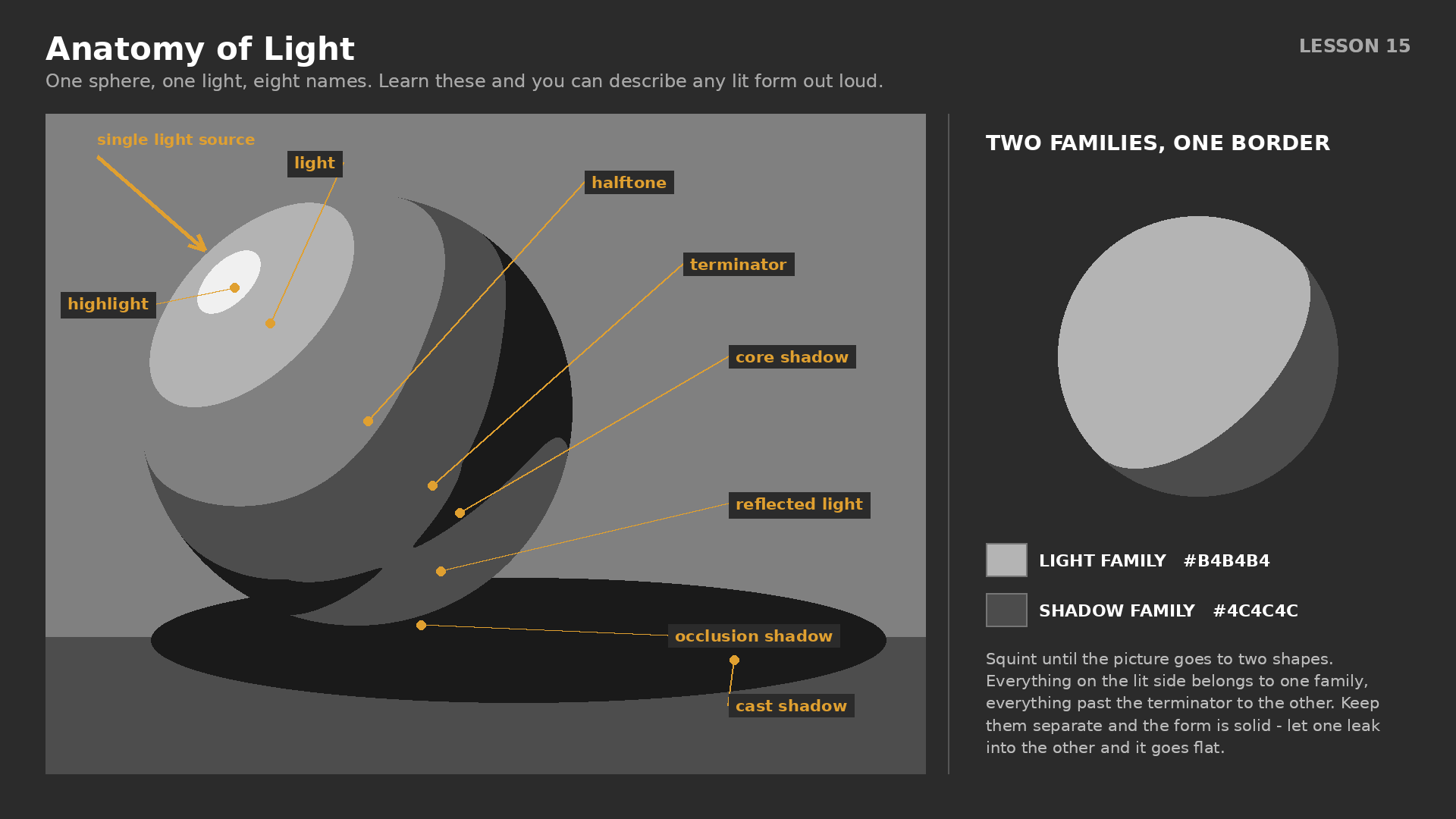
1920x1080 PNG, #2B2B2B background. A large rendered sphere on a plane occupying the left two-thirds, lit from upper left by a single source, drawn in five flat values only. Eight leader lines in #E0A030 point to and label: highlight, light, halftone, terminator, core shadow, reflected light, occlusion shadow, cast shadow. Right third shows the same sphere reduced to two flat shapes - light family in #B4B4B4, shadow family in #4C4C4C - under the heading 'two families, one border'.
Form vs Cast Shadow Worksheet
2000x1500 px PSD, 300 dpi. BACKGROUND #808080 locked. Locked layer OUTLINES containing white line art of a sphere, a cube and a cylinder standing on a common ground plane, repeated in three rows so the student can do three lighting variations. A locked layer LIGHT ARROW with a large arrow in the top-right corner. Separate empty layers named SHADOW SHAPE, RENDER and CAST SHADOW for each row. The five-value swatch strip from L14 embedded along the bottom edge on a locked layer.
CHECK YOURSELF
Can you answer these?
Answer out loud first, then open each one to compare.
Can you look at a shadow and say whether it exists because a surface turned or because something blocked the light?
The question to ask is whether the surface turned or something got in the way. A form shadow exists because the geometry rotated past the point where light can land on it — nothing is blocking anything — so it sits on the object itself and its edge softness is set by how fast the surface turns. A cast shadow exists because an object stood in the way and stopped light reaching something else, so it lands on another surface, is sharpest where the two objects meet, and softens and lightens as it travels away.
Can you explain why a box has a hard terminator and a sphere has a soft one?
Because the edge softness of a terminator is set by how fast the surface turns, not by taste. A cube turns instantly, ninety degrees at the corner, so light goes from full to none across no distance at all and the terminator is a hard line. A sphere turns gradually, so the falloff is spread out and the terminator is a soft, wide gradient. A cylinder shows both: soft around the wall, hard at the rim. Airbrush a soft terminator onto a box and it becomes a pillow; put a hard terminator on a sphere and it becomes a paper cutout.
Can you say what the shape of a cast shadow tells you about a surface you have not drawn?
It describes the terrain the shadow lands on. A cast shadow crossing a staircase breaks and steps; one crossing a curved wall bends around it; one running across a rutted floor rises and dips. So the shadow shape is doing two jobs at once — it gives the silhouette of the object blocking the light, and it maps the surface receiving it. That is why cast shadows are so efficient: they let you describe a floor or a wall you have barely drawn.
Can you keep every reflected light darker than every value in the light family?
This is the rule to enforce, and the check is to sample and compare: nothing in the shadow family may ever be as light as anything in the light family, reflected light included. Set the budget before you render — light family at values 1 to 2 on your five-step scale, shadow family at 4 to 5, value 3 as the halftone at the turn — then refuse to break it. Reflected light painted too bright is the single most common error in beginner rendering, because it punches a hole through the shadow family and the form dissolves. It is a shadow value lifted slightly, no matter how shiny the tabletop looks.
Go deeper
Ctrl+Paint library
https://www.ctrlpaint.com/library
Winged Canvas digital art resources
https://www.wingedcanvas.com/digital-art-resources
Drawspace
https://www.drawspace.com/
← Previous
The Five-Value System
Next →
Rendering Form